
Sustainability Analysis of AI Data Center Infrastructure
As AI use becomes increasingly widespread, data centers are a priority for tech companies looking to enter the cloud AI market. However, with the increasing commercial demand for this new technology, concerns are now shifting toward the substantial impact data centers could have on the environment, society, and the global economy. By discussing and analyzing the correlations between the environmental, social, and economic effects of data centers, we can analyze AI data centers’ place as a long-term investment.
ENVIRONMENTAL
What are the environmental impacts of AI data centers?
Studies assessing the carbon emissions and energy consumption of hyperscaler data centers found that these data centers consumed approximately 68-99 TWh of electricity and an associated 37-54 million metric tons of CO2 (Guidi et al., 2026). It was found that its electricity demand accounted for approximately 1.8% of total US electricity consumption, with 54% of that supplied by fossil fuels. The average carbon intensity was approximately 545 gCO2/kWh — 48% above the contemporaneous US national-grid carbon intensity of 370 gCO2/kWh.
Ever since AI became more prevalent in everyday life, global electricity demand has grown exponentially since 2015 and is expected to continue to grow by 2030. Most notably, the data center sector has accounted for the most growth in recent years, accelerating electricity demand growth after 15 years of stagnation (International Energy Agency, 2026).
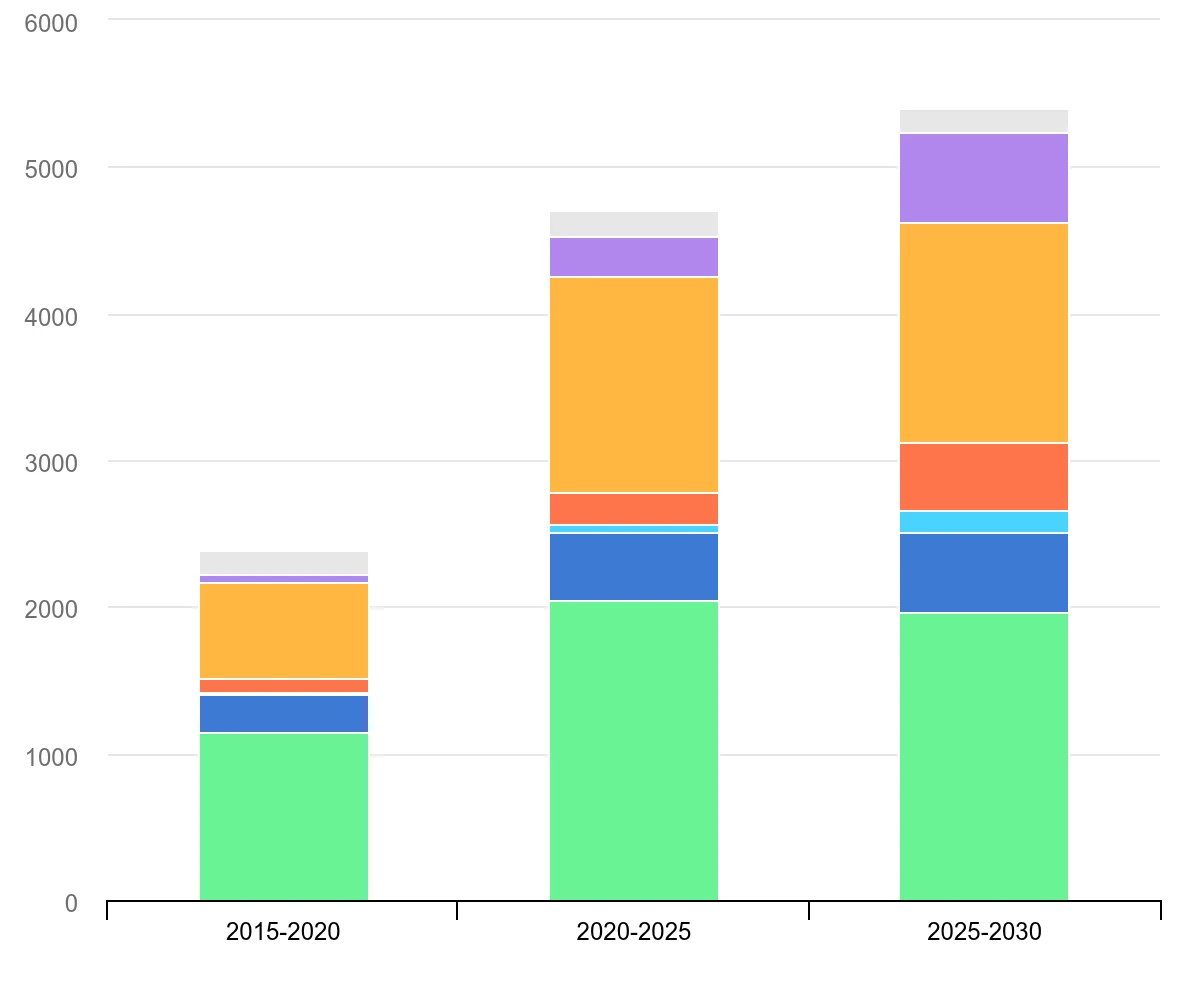
Global electricity total demand growth by sector and end-use, 2015-2030 (International Energy Agency, 2026)
Due to the power and energy required by hyperscaler data centers, cooling systems or heat pumps are necessary to remove excess heat. These systems consume energy, doubling their global electrical demand (heat pumps increased from 22 TWh to 457 TWh, and cooling systems rose from 260 TWh to 457 TWh). As such, global electricity demand is projected to outpace economic growth by 2030, making renewable energy, natural gas, and nuclear power necessary to meet this demand.
However, while heat pumps and cooling systems have increased global electrical demand due to data centers, most operations opt for water-based cooling instead, which is cheaper but consumes a significant amount of water. Large data centers can consume up to 5 million gallons per day (Environmental and Energy Study Institute, n.d.) (the water consumption of a town housing 10 to 50 thousand people). When data centers exceed the available water supply, these areas become water-stressed, affecting domestic, industrial, and agricultural stakeholders. As with carbon emissions and power consumption, data center water consumption will continue to increase as data centers grow in both size and prevalence.
Lastly, a less-discussed negative impact is noise pollution. Data centers (through construction, cooling systems, or backup diesel generators) can reach 85 decibels (Richardson, 2024)—a level of noise that can harm hearing—with some larger industrial units reaching 100 decibels, all lasting for hours or days at a time. This has reportedly been affecting residents in Virginia (Chan, 2023) who have experienced sleep disruptions, headaches, and lower quality of life. More than that, all this noise can cause local wildlife to flee their habitats, damaging local ecosystems.
How does this impact the effectiveness of AI data centers?
An efficient data center uses less energy, water, and material resources, all while delivering the same amount of computing power. However, due to the environmental impact of data centers, studies warn that nearly 80% of AI data centers are vulnerable to climate threats (Noor, 2026), such as floods and fires—all of which affect a data center’s long-term operational resilience and inevitably increase costs.
Climate is a key variable that can influence how well a data center can continue to run over the long term, as well as dictate potential disruptions and increase insurance costs. These chronic climate risk factors impact 54% of data center markets globally. This is especially true for the Asian-Pacific market, as it has an 89% exposure (Noor, 2026) to heat and droughts, making it the most vulnerable region.
SOCIAL
How have AI data centers impacted communities?
Much of the environmental impact of data centers is reflected in the communities that benefit and use the resources they consume. As such, the societal impact of data centers is mostly influenced by their environmental impact.
In the US, there are more than 3,900 data centers as of late January (Data Center Map, n.d.), with 60% located in Virginia. One of their main concerns is the soaring energy demand. Communities worry about the rising power bills, with Americans paying almost 10% more for electricity on average (Thyagaraja et al., 2025), with evidence showing that new energy infrastructure for data centers contributed to this price hike. This forced some states and utilities to explore ways to ensure that the cost incurred by data centers won’t shift elsewhere. Other states have also created new billing classes and rate structures so the cost won’t affect households and businesses (Samayoa, 2025).
Another concern from communities is that data centers exacerbate the already pressing problems of water depletion and drought, especially since most data centers were built in water-stressed areas (Arizona, the Colorado River Basin, and Texas) (Campbell, 2025). In some communities, this has already prompted public concern and governance action (SELC, n.d.), including the establishment of limitations on data center groundwater withdrawals, water-use monitoring, drought contingency planning, and site-specific water risk assessments.
Lastly, the construction of data centers reshapes land use (Bales et al., 2025) in many communities that compete for land for agricultural, rural, or urban purposes. The average data center covers about 224 acres (0.35 square miles), whereas hyperscaler data centers require campuses exceeding 1000 acres (1.6 square miles). Residents of affected communities now raise the concern that the rezoning for data center development could accelerate the loss of productive farmland,
The impact of data centers on communities isn’t entirely negative, especially as AI adoption increases in prevalence, influencing socio-economic structures, social relations, and governance (UNESCO, 2025).
How does this impact the longevity of AI data centers?
The relationship between data centers and the affected communities is cyclical. As AI continues to be adopted in everyday life, the demand for cloud computing and AI services will consequently grow, requiring more data centers capable of handling the workload. However, these data centers still face issues with power consumption, excess heat, and storage requirements, which, in turn, affect nearby communities, especially if demand increases. As communities quickly become reliant on AI, these negative impacts may also affect the longevity of AI data centers.
ECONOMIC
How have AI data centers impacted the global economy?
As recently as 2025, reports published by the UN Trade and Development have shown that data centers are a major force shaping global investment (UN Trade and Development, 2026). The demand for AI infrastructure and digital networks drove foreign direct investment to exceed $270 billion. Moreover, the surge in data center construction and AI-related spending is driving GDP growth, especially in countries like the United States, where most data centers are located. This expansion is largely due to pressures in out-competing each other in the AI market,
It’s widely acknowledged that data center development can create real economic opportunities (Walker & Goldsmith, 2026) for the community by generating hundreds of (albeit temporary) jobs for technicians, electricians, and other building trade workers. It can also provide opportunities for full-time staff, including technicians, security, and facility managers. However, these are fairly limited, with the largest number of permanent workers employed in a U.S. data center being 25. Data centers also generate revenue for local or state governments through property, sales, and use taxes (with some U.S. states offering tax incentives to attract data centers).
However, as more and more businesses adopt AI instead of upskilling, reskilling, or hiring, there have been extensive layoffs for white-collar workers and a decline in entry-level jobs (UNESCO, 2025). This is slowing employment growth, but GDP in countries that have invested in data centers remains strong.
CONCLUSION
Considering the environmental, societal, and economic impact of AI data centers, what is their place as a long-term investment?
Based on the research conducted, data center infrastructure seems to benefit the global economy the most of the three sectors. However, the social and environmental effects are inseparable, and most data center infrastructure impacts local communities the most severely. As such, while data center infrastructure and AI are profitable and seem to benefit the economy, they may prove unsustainable due to insufficient environmental resources and poor public perception, despite the utility of cloud AI.
To better preserve the economic boom of AI and data centers, companies should focus more on collaborating with government entities and minimizing the negative impacts of data centers to ensure their longevity. Operators must invest in more efficient technologies and processes while also ensuring that local governments are prepared to support communities and mitigate these effects. Adequate regulation will ensure that continued development will not interfere with local communities, encouraging more people to use it rather than continuing pushback.
Another recommendation is to focus more on optimizing the current infrastructure. By reducing environmental impact, data centers can lower costs, increase long-term operational resilience, and improve their performance. While there is currently no one optimal solution (Thompson et al., 2025), there are still ways to increase efficiency and decrease climate-related risks. These include optimizing cooling systems, investing in more energy-efficient hardware, and pivoting to renewable energy (Wickramasinghe, 2026), such as nuclear energy.
Sources
Bales, E., Riedford, K., & Lewis, E. (2025). 300 acres of farmland could be rezoned for new data center near I-70. https://www.wdtn.com/news/300-acres-of-farmland-could-be-rezoned-for-new-data-center-near-i-70/
Chan, R. (2023, November). Data center noise disruptions are frustrating residents in Loudoun County, Virginia. https://www.businessinsider.com/data-center-noise-disruptions-loudoun-county-virginia-2023-11
Campbell, D. (2025, June 25). How data centers are deepening the water crisis. https://www.businessinsider.com/how-data-centers-are-deepening-the-water-crisis-2025-6
Data Center Map. (n.d.). Data Center Map. https://www.datacentermap.com/
Environmental and Energy Study Institute. (n.d.). Data centers and water consumption. https://www.eesi.org/articles/view/data-centers-and-water-consumption
Guidi, G., Dominici, F., Squartini, T., Sprinkle, C., Gilmour, J., Butler, K., Bell, E., Delaney, S., & Bargagli-Stoffi, F. J. (2026). Assessing the carbon emissions and energy consumption of U.S. hyperscale data centers. https://arxiv.org/abs/2606.05420
International Energy Agency. (2026). Electricity 2026: Executive summary. https://www.iea.org/reports/electricity-2026/executive-summary
Noor, D. (2026, June 23). Data centers face increasing climate hazards, study finds. https://www.theguardian.com/us-news/2026/jun/23/datacenters-climate-hazards-study
Richardson, K. (2024, December 3). Understanding the impact of data center noise pollution. https://www.techtarget.com/searchdatacenter/tip/Understanding-the-impact-of-data-center-noise-pollution
Samayoa, M. (2025). Oregon Legislature passes ‘POWER Act,’ targeting industrial energy users like data centers. https://www.opb.org/article/2025/06/05/oregon-data-centers-cryptocurrency-business-environment-power-electricity/
SELC. (n.d.). Google agrees to limit groundwater use from S.C. aquifer. https://www.selc.org/news/google-agrees-to-limit-groundwater-use-from-s-c-aquifer/
Thompson, D., Macfarland, M., Ellis, T., & Laudisio, V. H. (2025). Data center sustainability faces challenges amid growth. https://www.spglobal.com/en/research-insights/special-reports/look-forward/data-center-frontiers/data-center-sustainability-faces-challenges-amid-growth
Thyagarajan, A., Friedman, J., & Levin, A. (2025). Electric and natural gas utility rate hikes tracker. https://www.americanprogress.org/article/electric-and-natural-gas-utility-rate-hikes-tracker/
UNCTAD. (n.d.). Data centres are reshaping the global investment landscape. https://unctad.org/news/data-centres-are-reshaping-global-investment-landscape
UNESCO. (2025). Societal implications of AI: Insight from signals. https://www.unesco.org/sites/default/files/medias/fichiers/2025/12/Societal%20implications%20of%20AI%20-%20Insight%20from%20Signals.pdf
Wickramasinghe, S. (2026). Data center optimization. https://www.splunk.com/en_us/blog/learn/data-center-optimization.html
Walker, C. D. & Goldsmith, I. (2026). U.S. data center growth impacts. https://www.wri.org/insights/us-data-center-growth-impacts