
The AI Efficiency Paradox: Better Chips, Bigger Power Bills
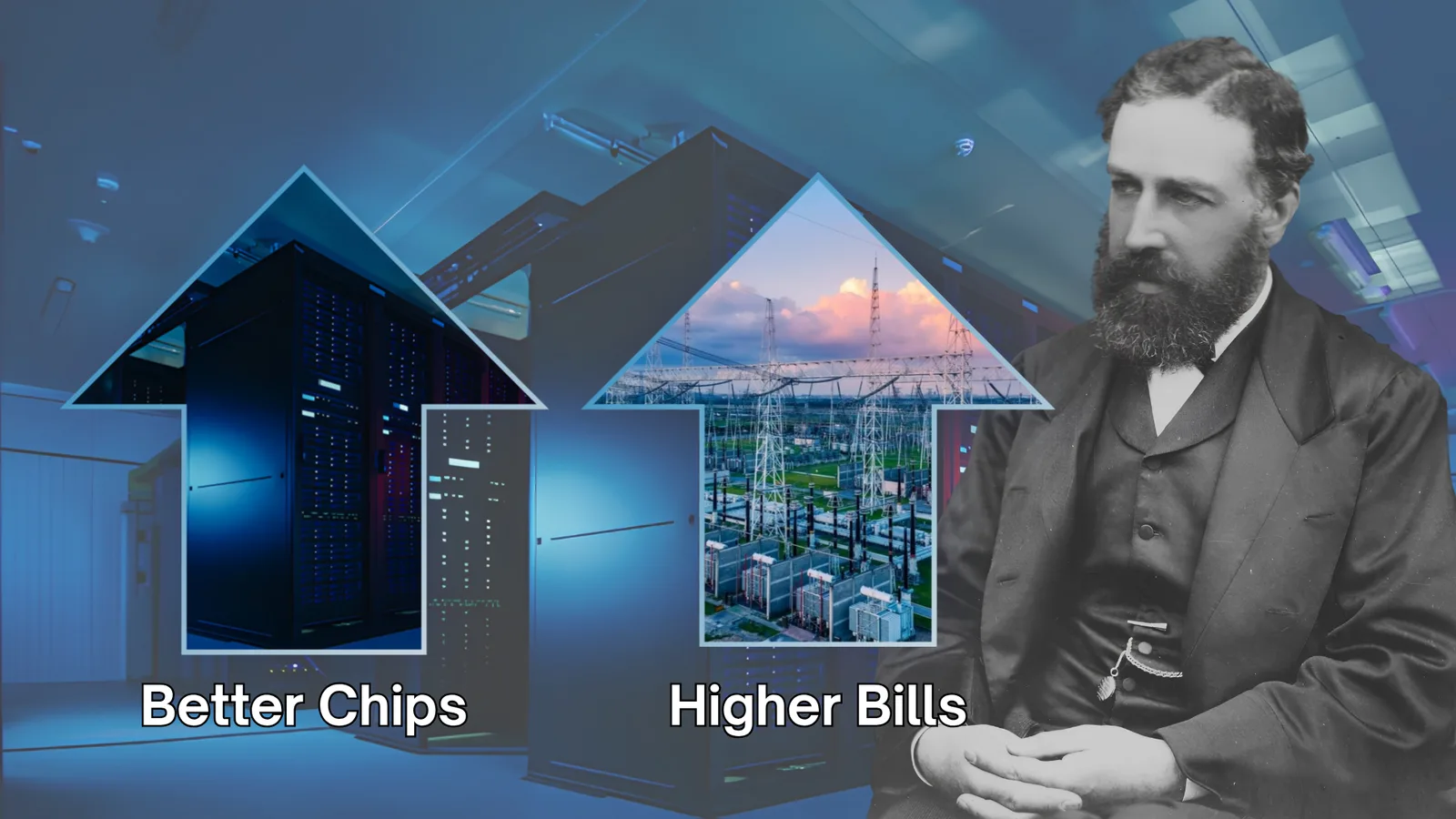
While AI compute is becoming increasingly more efficient, total data center power demands continue to rise. The AI accelerators, servers, networking, memory, power conversion, and cooling necessary to support these data centers put heavy strain on an area’s power grid and water supply—a source of backlash. Many companies must optimize their infrastructure by minimizing total energy consumption while maximizing compute utilization. However, efficiency alone does not guarantee lower total resource consumption, especially as AI demand and workload intensity increase.
Data Center Energy Conservation Framework
Energy efficiency and reliability have been a critical concern even before the AI boom (Rong et al., 2016). Over the past decade and a half, data centers have made considerable efforts to ensure energy efficiency and reliability, while avoiding excessive facilities to reduce global warming. However, with the commercialization of AI, the call for sustainability intensifies.
The energy conservation framework for data centers considers the different factors that can influence its energy consumption. These factors include high-performance computing (software), low-power (or more energy-efficient) server design (hardware), energy conservation in computer rooms, and renewable energy applications—all of which influence data center energy efficiency (Rong et al., 2016).
High-Performance Computing (Software) & Energy-Efficient Server Design (Hardware)
AI data centers require high-performance computing capabilities, advanced storage architecture, and resilient and secure networking. Maximum efficiency means low-power servers play a pivotal role in improving a data center’s sustainability. Hyperscalers include components like specialized ARM-based energy-efficient processors (Ozkal & Hillariet, 2026), High-Bandwidth Memory (HBM), solid-state storage solutions like Non-Volatile Memory Express (NVMe) (Kingston Technology, 2025), and intelligent power management—all of which help data centers maximize computing power efficiently.
Energy Conservation of Computer Rooms
In a data center, computer rooms are secure spaces that essentially house the different hardware involved in a data center, such as server racks, data storage units, and networking hardware. These computer rooms tend to consume a lot of power and generate a lot of heat. Cooling systems—like liquid cooling or immersion cooling—keep the infrastructure running smoothly. As such, energy conservation involves upgrading these cooling systems, using specialized efficient chips, and building localized power sources to reduce stress on public utilities.
Renewable Energy Applications
Another way companies increase data center efficiency is to apply renewable energy in their processes. AI data centers, in particular, are power-intensive and require electricity at all times to keep running. Renewable energy is integral to data center development, helping them circumvent grid bottlenecks in certain geographic areas. Currently, solar and wind power supply approximately 24% of U.S. data center electricity (International Energy Agency, 2025).
Challenges for Energy-Efficiency in Data Centers
Contrary to popular belief, operators have been implementing these energy-conserving components to increase compute efficiency. Businesses have spent significant effort to ease the cost of running data centers. If they are not implementing more efficient IT components, they focus on decreasing their carbon footprint or integrating renewable energy.
For instance, Google reportedly has an average annual power usage effectiveness (PUE) of 1.09 for its data centers, delivering three times more computer performance per unit of energy than five years ago (Google Data Centers, n.d.). The closer the PUE ratio is to 1.0, the less energy the facility uses outside of IT equipment (Google Data Centers, n.d.).
The lack of sustainability causes public outcry from those affected by these data centers, while the companies in charge make efforts to conserve energy. This begs the question: why haven’t these strategies made a big difference?
The crux is simple: demand for AI and data processing eventually overwhelms any compute efficiency gains. Jevons’ paradox describes a phenomenon in which a technology becomes more resource-efficient, and the demand tends to increase (Rosalsky, 2025). As AI becomes more efficient, accessible, and convenient, demand for AI processing power (already resource-intensive) inevitably rises.
For example, despite Google’s low PUE, its carbon footprint increased by 18% in 2025 from last year and by 81% from its 2019 baseline emissions (Johnson, 2026). Similarly, Meta also has a PUE of 1.09, but its data center electricity consumption increased by approximately 21% in 2024 (Meta, 2025).
As such, a lower PUE does not mean less power (renewable or otherwise) being used, fewer environmental effects, or a lower total energy demand. PUE indicates how well a data center uses the power it consumes, but AI demand keeps power consumption stagnant or even increases it, despite better compute-per-watt.
What are the Next Steps for AI Data Centers?
Despite companies minimizing energy consumption through their servers, computer rooms, and renewable energy options, AI data centers still struggle to remain sustainable. They still consume vast amounts of electrical energy. This is because AI demand overwhelms companies’ efficiency attempts. As such, efficiency measures alone can not ensure an AI data center’s sustainability. It must be paired with capacity planning, power-aware design, energy sourcing, siting, and demand management.
What then should data center operators optimize when total power—not compute availability—is the constraint?
References
Google Data Centers. (n.d.). Power usage effectiveness. https://datacenters.google/efficiency/.
International Energy Agency. (2025). Energy and AI, IEA, Paris. https://www.iea.org/reports/energy-and-ai, Licence: CC BY 4.0.
Johnson, L. (2026, July 2). Google’s emissions continue to climb due to AI buildout. ESG Dive. https://www.esgdive.com/news/googles-emissions-continue-to-climb-due-to-ai-buildout/824373/.
Kingston Technology. (2025, March). The importance of SSDs in data centers: Expert insights. https://www.kingston.com/en/blog/servers-and-data-centers/important-role-ssds-video.
Meta. (2025). 2025 environmental data index [Data report]. https://sustainability.atmeta.com/wp-content/uploads/2025/10/Meta_2025-Environmental-Data-Index.pdf.
Ozkal, K., & Hillariet, C. (2026, July 15). Arm powers the world’s most advanced and energy-efficient supercomputers. Arm Newsroom. https://newsroom.arm.com/blog/arm-powers-energy-efficient-hpc-supercomputers.
Rong, H., Zhang, H., Xiao, S., Li, C., & Hu, C. (2016). Optimizing energy consumption for data centers. Renewable and Sustainable Energy Reviews, 58, 674–691. https://doi.org/10.1016/j.rser.2015.12.283.
Rosalsky, G. (2025, February 4). AI, DeepSeek, and the economics of Jevons’ paradox. Planet Money. https://www.npr.org/sections/planet-money/2025/02/04/g-s1-46018/ai-deepseek-economics-jevons-paradox.
Server Simply. (2024, September 30). Low-power servers: Maximizing efficiency in modern computing environments. https://www.serversimply.com/blog/low-power-servers.